Listening In

Thursday, December 17, 2009

極落、極落: House of fallen persimmons, shrine of fallen leaves


18th December 2009


Rakushisha (落柿舎) is one of those attractions where people hover at the threshold, wondering if the place will be worth the entrance fee.

This is what you can see of the hermitage from the outside in autumn: persimmon trees, maple leaves and a thatched roof.


Fans of Matsuo Basho don't hesitate. Even if the current Rakushisha is a reconstruction, the original was visited by the poet three times and that connection is enough for them.

You may not be able to read the poems on the wooden plaques hung in the garden or carved on the stones. But lines in wood need no translation.


And sunlight is a universal language.


If you feel like writing a haiku, there is paper for you.


The owner of Rakushisha, poet Mukai Kyorai, probably won't read it seeing as he died in 1704. But a raincoat and hat are hung from a wall to show that the owner is in.


So you never know.


On the other hand, there is no entrance fee for Iwato Ochiba Jinja (岩戸落葉神社), a tiny mountain shrine northwest of Kyoto city. Some say that the shrine used to be called Ochikawa shrine but became known as Ochiba Jinja - the fallen leaves shrine.

In late autumn, the gingko trees soaring over the shrine shed gold leaf all over the grounds.


The leaves fill the stone basin where worshippers purify their hands and mouth.


And among the gingko, some maple too. Autumn in Kyoto wouldn't be the same without it.

Tuesday, December 15, 2009

Photos for the Tooth Fairy crowd


15th December 2009


People may be coming to this site. I can't tell because the gnome whose job it is to track blog visitors has not showed up for work for a few days. I suspect that it's because I did Something Technological.

So the presence of site visitors has become hard to prove - rather like verifying the existence of the Tooth Fairy. But here are some photos for those who may or may not be here.

Before the Arashiyama Hanatouro light-up, I found a pyramid of turnip outside a pickle shop.


Then the lights came on in the bamboo forest.


It was cold enough to see my own breath, which meant that this hawker did a brisk trade in hot sweet potato snacks, mitarashi dango and other things on sticks. Cocoa, as the sign says, costs 200 yen a cup. There didn't seem to be any turnips on sticks though.


Sunday, December 06, 2009

Lights in the mountain, lights in the bamboo


7th December 2009


If you're in Kyoto this week or the next, don't miss the Arashiyama Hanatouro. The light-up in the west of the city covers about 5.2km of waterfront, bamboo forest and ikebana-lined trails.

The place will probably be heaving with people if you go on the weekends but at least the crowds will keep you warm.

Friday, December 04, 2009

A word from the blogger


4th December 2009


I, er, appear to have done Something Technological. Er.

You may notice that the blog is looking a little different. Believe me, I'm surprised too and I was the one doing the clicking.

And if you like to click on buttons, there's a new one here for you. Look for the word 'Follow' at the top of the blog then finger + mouse.

Good things may happen. If nothing else, there's safety in numbers.

Thursday, December 03, 2009

A walk in the woods


3rd December 2009


The road in to Shimogamo Jinja runs through a forest. It runs long and straight: long enough so you do not approach lightly and straight enough for you to gather arrow intent as you move to the shrine.


Through the gateway after the place of purification.


And inside:


Autumn left in glorious tatters.

Wednesday, November 25, 2009

Autumn leaves and not-urinals


28th November 2009


Kyoto's November is lovely but Kyoto has been around for centuries and news of that loveliness has got out.

Kyoto's November is crowds and coach buses.

Still, there are a few spots left where you can find autumn colours and take a picture of them without the population of Greater Tokyo - last seen in your sakura photos - appearing as well.

Seiryo-ji, better known as Saga Shakado, in the west of Kyoto is not on the list of famous momiji temples so it doesn't have the profusion of maples that, say, Tofukuji does.

But it has a great garden, intriguing angles and enough quiet for you to think (or not think, if you practise Zen) even in the height of the fall frenzy.


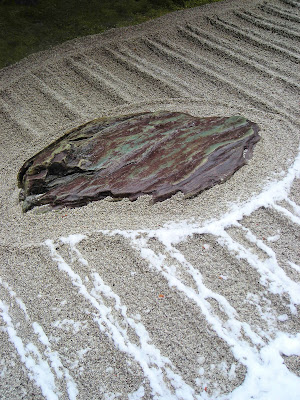
An Edo-period stone garden (karesansui). Not, as you may first think, a urinal that fell over.


But some of the best sights are not to be found at your destination but along the way. Like this gentleman looking out at the world from the walls of his garden.


And these friendly faces near an Arashiyama bus stop.


Thursday, November 19, 2009

Land of the small and cute


19th November 2009


As I left a mall today, a man was wheeling his bike out to the road. In the child seat was a little girl in pink.

Our eyes met. Large eyes, rosy cheeks, runny nose. I smiled. Most toddlers take a little time to consider you - animal, vegetable or mineral? - before deciding whether or not to smile back but this kid just grinned.

Her father wheeled her away. In the front basket was stuffed a new pillow wrapped in plastic. It was as big as she was.

My smile lasted all the way to the supermarket, where I had to put it away because if you smile for no apparent reason, people look at you funny.

Though I bet they wouldn't if I had rosy cheeks and a runny nose and was no bigger than a pillow.

Sunday, November 08, 2009

The Lazy Gaijin: Fairly Edible Meals Made With Ingredients From A Japanese Supermarket And A Minimum Of Fuss

Recipe No.1: Onion and sweet potato soup


8th November 2009


There are lots of things I'd like to do this lifetime. Some are one-off events, like seeing the Northern Lights, while others are more in the line of ongoing missions. This is one of the latter: making good soup without messing around with bones or resorting to stock cubes and powders.

I invented a fairly edible soup on Saturday which fulfils these two requirements. Here's the recipe. (The measurements will be approximate because life's an adventure and sometimes cooking is too.)


Makes 3 servings
Ingredients:


Water, 1 litre

Pasta water, around 250 cc (left over from cooking lunch. Probably doesn't make much difference if you leave it out)

Big onions, 3 (because they came in bags of 3)

Small Japanese sweet potatoes, 3 (ditto)

Konbu, 1 piece (Pronounced kombu but spelled konbu. I was aiming to use a 10 cm square piece but the one I pulled out of the bag was bigger and I couldn't be bothered to cut it so... I've been wondering why konbu is used so much in Japanese stocks. I believe it's added for umami. And perhaps for luck)

Tofu (however much you want to eat)

Chicken (As above. I got enough to cover my hand because a packet with that much was going for 30 per cent off at the supermarket)

Soya sauce or salt (I ended up using both)

Sake (Probably optional but I used it to marinade the chicken. You can also drink it if you get thirsty. No one will check if you're old enough to)


Here we go:

1. Wipe the konbu (pronounced kombu but spelled konbu) with a wet cloth. I'm not sure why this is necessary but Harumi Kurihara says to and I don't argue with her. At least, not very loudly).

2. Put the konbu in a pot with the water and pasta water that you may or may not be using. Leave for 10 minutes then light a fire under the lot. Harumi-sensei says to take the konbu out when the water becomes warm, whatever that means. I interpreted this to be that stage before serious bubbles appear in the water.

3. While the konbu was doing its 10 minutes in the pot, you should have cut the chicken up into pieces that will fit into your mouth and marinaded them with soya sauce and optional sake. I used however much came out when I poured in one circular motion over the bowl.

4. Cut up the onions. The smaller the pieces, the less boiling time but on the other hand, you'll suffer onion fumes for longer while dicing with death. If the water is boiling, dump in the onion as quickly as you can.

5. Cut up the sweet potatoes. Again, the smaller the better. And this time, there are no fumes, hurray!

6. Oh, and add the sweet potatoes to the pot.

7. Keep the boil going until the onions and sweet potatoes almost dissolve. If you've finished the washing-up and start to get bored, you can speed up the process by hitting them with a ladle or something.

8. When you add the chicken is up to you. I dumped it in when I couldn't stand the suspense any longer. And anyway, I wanted to wash the bowl it was in.

9. At some point, put in the tofu. You can dice it first or just toss it in and hit it with your ladle. Tofu rarely fights back.

10. The timing of the spinach addition - oh bugger, I forgot to put spinach in the ingredients list - is far more important. Spinach does not seem to be one of those things that take kindly to boiling so throw it in only when you're ready to serve.

11. When are you ready to serve? When the water level in the pot goes down, the onions and sweet potatoes have turned into a kind of sludge and your stomach starts to make socially unacceptable noises, it's time to add the spinach and wrap up this gig. First aid measures involving soya sauce or salt will probably be necessary. And a little prayer never hurts.


Verdict:

It doesn't taste half-bad. The yellowish-grey colour of the soup is regrettable but you can always close your eyes. It also explains why there are no photos in this post. The main thing is, the stuff is edible and the flavour didn't come from roasting bones or stuff that will make your hair fall out. This is an experiment I plan to repeat.


(I also posted this in the other blog but no one seems to go there. Which is fair enough, seeing as I hardly post in it.)

Thursday, October 29, 2009

What I did during my vacation


Eve of All Hallows, 2009


I queued. I didn’t really mean to. When I packed to leave Kyoto for Singapore, I didn’t plan to do much more than catch up with people and books I hadn’t seen in months.

But avoiding crowds was high on my list of things to do. So was staying out of any kind of queue because there are only so many people you can go on holiday with.

Then it was announced that Neil Gaiman would be appearing at the Singapore Writers Festival at the end of October.

Are introductions in order? Neil Gaiman: author of The Sandman, a fantasy series that has become so much of a hit that the comic books are now called graphic novels, and writer of short stories, novels, poems, film scripts and children’s books. Of these, The Graveyard Book has spent over a year on the children’s best-seller list of the New York Times though everyone I know who loves the work is old enough to drive.

It’s a reimagining of The Jungle Book; instead of a boy being brought up in a jungle by animals, he’s brought up in a cemetery by dead people. And a vampire.

The novel may well turn out to be one of those books you keep returning to and measuring yourself against, like standing beside a mark scratched on a wall to show how tall you were at nine because you want to see how much you’ve grown.

So great that the author would be coming to town, yes? There was only one snag: all the tickets for his three events were gone on the first day of distribution, even though it was announced only via Twitter.

To accommodate the demand from everyone not on the Twitter feed, the festival staff increased the venue capacity and announced that they would release a ‘VERY VERY LIMITED number of tickets’ on Sept 26.

When I read this on the festival website, I began to see visions of queues. There’s one thing I haven’t mentioned about Mr Gaiman. Yes, he’s versatile, yes, he’s prolific and yes, he wins all those awards but what he really is, is a queue-maker (like a rain dancer but more horizontal).

The mere hint of his presence is enough to draw previously unconnected people out of the great mass of humanity and assemble them into a line. This happens all over the world – at literary festivals, bookstores and conventions – and I knew it would happen on Sept 26 at The Arts House because of the promise of tickets to see He Who Brings Queues.

The question was, how early would I have to turn up before the distribution time of 11am if I wanted to be sure of a pair of those VERY VERY LIMITED tickets?

It didn’t help that I work late and go to bed even later. But after crashing out for five hours and hitting the alarm clock’s snooze button for half an hour more, I stumbled into the kitchen at 7.30am.

My mother was there. ‘You mean you haven’t gone to bed yet?’ she said.

Then again, she might not have been my mother. Since I’m technically not awake between the hours of 6am and 9am, anyone I see then must be a figment of my imagination.

The taxi-driver looked pretty real though. I asked him to take me to Parliament House – near The Arts House but not in the area closed off for the F1 races that weekend. He frowned. I held my breath: was he going to refuse to go anywhere near the barricades?

It turned out that he just didn’t know where Parliament was.

But between the both of us, we got there. It was almost 9.30am – one and a half hours before the box office’s opening time – when I made my way past the F1 barricades and security personnel to The Arts House.

Two girls in short shorts were approaching from the venue. ‘…queuing since 6.40!’ said one of them as she went past.

I stopped. What if the line had reached such epic proportions that those two had given up and were on their way home?

I kept on walking. Even if I didn’t get the tickets, there might be a story in it. To be a writer is to slink up to life with a scavenger’s optimism.

The queue began at the locked front door and snaked out of the portico. Since each person was eligible for two tickets, the line was actually twice as long as it appeared. Was I too late?

I left my bag at the end of the queue to stake a spot in that fine Singaporean tradition of chopeing and went to talk to the people up ahead. The first person in the line said she’d been there since 6.40am. She beamed at me, her smile and light green tudung unwilted despite the heat. No. 2 clocked in ‘just past 7’ and No.3 and No.4, at around 7.30am.

Humbled, I went back to do some proper queuing. I’d brought two books but a conversation was starting up in my neck of the queue, mainly about the tickets. One woman confessed that she was hoping that the F1 road closures would deter fans from coming. I had the same thought; devious minds think alike.

To pass the time, we reminisced about other occasions when Singaporeans had gotten into line and stayed there for hours. But the girl behind me was from the Philippines and knew nothing about the Great Hello Kitty Scuffles of 2000.

In the January of that year, McDonald’s launched a promotion offering customers Hello Kitty toys with each Extra Value Meal they bought. Lines sprang up, tempers grew short, fights broke out and people were arrested. At one outlet, a glass door broke against the press of the crowd, injuring seven.

You can think of a queue as a social microcosm. In one line, you’re told what a society values, how much it wants it, how much trust there is in the system to provide it and whether people will resist the urge to jump the queue.

Almost 10 years on from the Hello Kitty Scuffles, how was Singapore doing? The line outside The Arts House that Saturday morning presented the country as orderly and international.

But the nature of the queue might have had something to do with the fact that it was there for Neil Gaiman. For a start, more people were reading than fiddling with their phones.


Still, there was no guarantee of what would happen if there weren’t enough tickets to go round. Some of the books people were holding looked pretty heavy. If the situation turned Hello Kitty, things could get ugly.

For now though, everything was calm. A trio went past, wheeling a trolley of equipment – probably for an F1 event. They seemed surprised to see so many people sitting in a line on the ground and reading.

10.05am – an hour to go and the sun was weighing down. Anybody want to share life stories?

So I talked to the five people around me in the queue. There was Kim, a student from the Philippines, Xuemei, a civil servant, Eldred, who draws, Wanida, who works for Apple and had come with a laptop, and Pat, who handles administration at a polytechnic, has five children aged three to 14, takes all of them on holiday, teaches women to give birth and is on the fast track to a medal.

She said that if she got a pair of tickets, one would go to her 13-year-old son, also a fan.

‘And where is he?’ I asked.

‘At home,’ she said and laughed. ‘Sleeping.’

There was a collective intake of breath as we considered the likelihood of our mothers queuing up for Neil Gaiman tickets for us while we stayed in bed.

‘I don’t think my mother even knows who Neil Gaiman is,’ said one woman who will remain anonymous in case her parents read this.

On his blog, he describes himself as the ‘guy you’ve never heard of’ who ‘gets more people in his book-signing line than anyone else’. This line has been known to stretch to about 600 people.

Our queue was nothing along those lines but everyone in it was competing for a fixed number of tickets. The conversation flowed, snagging at times on the uneasiness underneath.

Two people ahead in the line stood up and shook out their groundsheet. ‘Do you think they’re giving up?’ someone asked hopefully.

‘They came with a mat – they’re not going to give up,’ someone else growled.

Sure enough, the two rearranged their sheet and sat down again.

I looked away to see an old man staring at us. A cap of flashing pink sequins on his head, he shuffled past, a smile crinkling his face. ‘Ni men hao!’ he bellowed. Hello to you too. Perhaps it takes a lunatic to acknowledge a whole line of them.

People were still arriving. They would do a double-take at the queue which now stretched along the front of the building and onto the grass at the other side. Then they would go to the end, their shoulders slumped.

11am – my queue buddies and I stood up. We paused only to get each other’s contact details then faced forward as if we could see through the bodies to the number of tickets left. Were people still talking? I don’t know; I couldn’t hear them any more.

And then I finally reached the table where the festival staff were handing out tickets from three dwindling stacks.

Maybe I was sunstroked out but I couldn’t quite believe it, not even when two tickets were in my (newly tanned) hand. The five who queued with me had their tickets too and all of us had picked the same event. ‘Let’s meet for lunch or something before that,’ said Kim.

Outside the portico, a burly, long-haired man in black was taking a photo of his tickets.

But not everyone was happy – about 20 people had to go away empty-handed. Amid the cries of disappointment, one young girl looked stricken. A few people exchanged words with the festival staff but as far as I could tell, they were polite. Perhaps we’d come out from under the shadow of Hello Kitty.

I couldn’t leave without seeing how it all ended because the conditions that give rise to a queue are also those that create a community: people with the same purpose come together, demanding attention through presence. But there is also envy of those ahead and a gnawing anxiety that you won’t get what they will. The factors are always the same yet the manner in which similar desires are balanced against competing interests is different each time.

So I stayed because I wanted to see what kind of queue, what kind of community we’d made. And when I left at last, I took more than tickets away with me.

When I got home, I headed straight for the shower, relieved that for this at least, I didn’t have to line up.

Because you know what I said about queues and community-building and all that stuff? When it comes to the bathroom, none of it applies.

Tuesday, October 20, 2009

Egmont and the seventh


20th October 2009


A concert again after so long away and the NY Philharmonic after even longer. This time, Beethoven was the one singing in the dark.

The brass was a little...startling but the strings alone were worth the (nosebleed) price of admission.

I'd have heard more of them if the audience hadn't been so quick to clap. An orchestra doesn't stop playing even after the fingers lift away and the bow leaves the strings. When the sound is gone, sound remains - an echo encore drifting in a space where no wind blows.

But applause slaps the sound away.

Wait, won't you wait a little longer? Only the first of the snowflake sound has fallen on my tongue.

Tuesday, October 13, 2009

Undead 101


13th October 2009


So I was working on a column today and for reasons I'll make up later, it suddenly veered off into the subject of zombie killing.

At which point I realised that I had no idea what to do if a zombie came through the door. I didn't think that the Internet, wide and Wikified as it is, would have any information on it either but I typed "zombie kill" into the Google search field anyway and hit enter.

Oh me of little faith.

Pages and pages of information. Whether the suggestions have been field-tested is another question but at least they're there - with brain diagrams and everything. There's even a game where you can kill zombie squirrels.

I wonder if virtual undead rodents come under the SPCA's purview.

Monday, September 21, 2009

Paths we have not known


21st September 2009


Sometimes, it is the road more travelled that haunts us.

'Friends who seemed pretty much indistinguishable from you in your 20s make different choices about family or career, and after a decade or two these initial differences yield such radically divergent trajectories that when you get together again you can only regard each other’s lives with bemused incomprehension...

'Some of my married friends may envy my freedom in an abstract, daydreamy way, misremembering single life as some sort of pornographic smorgasbord, but I doubt many of them would actually choose to trade places with me. Although they may miss the thrill of sexual novelty, absolutely nobody misses dating...

'Quite a lot of what passes itself off as a dialogue about our society consists of people trying to justify their own choices as the only right or natural ones by denouncing others’ as selfish or pathological or wrong. So it’s easy to overlook that hidden beneath all this smug certainty is a poignant insecurity, and the naked 3 A.M. terror of regret.'

- Tim Kreider, The New York Times' Happy Days blog


Then there is novelist Guy Gavriel Kay, writing in Tigana: 'There are no wrong turnings. Only paths we had not known we were meant to walk.'

A comforting belief but one which - and I know this from long years of trying - takes work.

Friday, September 04, 2009

For all you kids who want to be writers...


4th September 2009


...I should disclose the amount on my latest royalty cheque. After a year of sales, the figure came to a grand total of $3.95.

Well, that should give the taxman heart palpitations.

So...time for a commercial?

Time for a commercial.

"Singapore. Malaysia. Brunei. We share a region and now we share a book. Punched Lines: Sit-down Comedy From Southeast Asia - already at a bookshop near you!"*

I wrote this in 2001: "In a country with four major races, English has become the neutral linguistic ground and that neutrality has crystallised in the form of the acronym. Other countries use it too of course - for companies, transport systems, rebel groups - but Singapore is umbilically attached to it. Hospitals, schools, banks, expressways - we are born in collections of letters to travel on them, study in them and give them our money."

It's still true. And thanks to Punched Lines, I'll be giving my bank $3.95 this year.


Let's shoot for $4.95 in 2010!


*Assuming that you're near Select Books in Tanglin Shopping Centre.

Sunday, August 23, 2009

The universe next door


23rd August 2009


From Ingram my American neighbour, I learned that the bathroom really is a dangerous place.

In Kyoto to research the Japanese legal system, he once went to a public bath. He knew the ritual involved – shower before you get into the bath – but he wasn’t expecting what would happen with the two old men in it.

They’d never seen a naked Jew before and proceeded to ask very probing questions. At his most vulnerable and unable to speak much Japanese, he did his best to explain circumcision anyway. The old men were astonished and kept on asking questions. He soldiered on with the explanations and emerged from his bath with his composure a little dented but his sense of humour intact.

From Klaus my German neighbour, I learned how to open jars with stubborn caps. Slip the point of a knife into that thin space between the edge of the lid and the jar and lever up. Once you hear a pop, the lid will come off without a fuss.

Open a jar for someone and he’ll have an open jar. Teach him how to open it and he’ll be able to eat from jars for life.

The jar Klaus taught me to open was one of rotkohl, pickled red cabbage from Germany. He taught me that rotkohl is better hot than cold.

A retired maths teacher, he spends half the year in Japan with his Japanese wife and the other half in Hamburg. They met at an English school in South Africa.

But he also spent time studying the language in Malta – ‘it’s cheaper than in England’ – and on the Maltese island of Gozo, he met an old man with a thousand books.

When he was young, the man left for the United States to look for work. Once he found it, he crammed it into his life, working for as much as 20 hours a day. He had no time for the books he loved so he collected them, intending to read them when he retired.

In time he grew rich and when he retired, he had a printing company to pass on to his children. He moved back to Malta, built a splendid house and began to read.

All had gone according to plan except for one thing: he was losing his sight.

My neighbour spoke of him as an old man in a room full of books he would never be able to read. He told Klaus, don’t wait.

A year later, Klaus retired. He was 49. Since then, he’s spent his time travelling and learning languages: first English because he wanted to read more about politics and now, Japanese.

His wife Kimiko said he could spend as much as 10 hours a day studying. They don’t have much but, as Klaus said, 'we don’t need much'.

From Maripass, I learned that when a Mexican says a chilli pepper is harmless, to take her words with a sea of salt.

And if the same Mexican tells you a chilli is hot, there’s no need to check for yourself unless you’re interested in near-death experiences.

From Lars the guitar-strumming Swede and Peter the Norwegian, who cross-dressed as a fairy one Halloween, I learned that the image of Scandinavians as a sober, reserved folk does not give the entire picture.

From Kim the South Korean, I learned that you can play Celine Dion on a bamboo flute.

Whenever he started warming up, I would open my door to hear him better. After he was done with the traditional tunes, he would move on to the Titanic song.

He introduced himself as a businessman when we first met but after we got to know each other better, he told me that he was a political refugee.

His exact words: ‘I write on Internet, I hate (name of politician). And police catch me.’

My first thought: is this guy for real?

He spoke little English and less Japanese and I didn’t know Korean so conversations took time. But when he showed me pictures of his wife and children, the look on his face said enough.

After a few months in Japan, he told me that his legal adviser in Seoul had called to say that it was safe to return.

I still don’t know what to make of his political dissident story but I can believe in the shochu he shared, in his parting gifts of pine nuts and ginseng snacks, and in his music – even the Celine Dion.

From the family of northern Chinese whose names I never found out, I learned nothing but received handmade dumplings, so many I ran out of vinegar.

From the Australian who might have been called Becky, I learned that when the Internet disappeared, I should go into the mysterious room under the stairs, insinuate my hands into the nest of wires, pull out all the plugs I could find then put them back.

On occasions like this, residents, including those I’d never met, would pour out of their rooms saying, ‘Is it just my computer or…?’

Then as we stood around, waiting to be connected, that would be the time to start learning about the neighbours, and from them.

Tuesday, August 18, 2009

Summer faces

18th August 2009


If you say hello, they'll say hello back. It's all rather friendly at the Kyoto Botanical Garden.

Thursday, August 13, 2009

Listening to a people hear


13th August 2009


This tells you a bit more about cicadas than the published version.

And for those interested in finding out more about Japanese onomatopoeia, here are the grammatical terms:

- 擬声語 giseigo or 擬音語 giongo (words that mimic sounds that actually exist in nature)

- 擬態語 gitaigo (mimetic words used to convey actions, non-auditory senses, bodily feelings or mental states. The last two are sometimes classified as 擬情語 gijougo).

...


If dogs go woof and pigs go oink, what do cicadas say?

Now that it’s summer, they sing through the long days and short nights but I still don’t have the exact word to pin down their chirring.

When muffled by a closed window, the sound falls on the ear like a maracas chorus but when heard under trees shrilling with cicadas, it bares jagged teeth. Listen long enough and it could saw your head in half.

If dogs in Japan go wan-wan and pigs go buu-buu, what do cicadas say?

It depends partly on the species. There’s jiii-jiii, miii-miii while another kind has been named tsuku tsuku boushi because that is, apparently, what part of its call sounds like.

Many races have listened to the world and tried to capture its sounds as exactly as possible. Wan-wan is not one of a kind when there’s woof woof, ouaf ouaf and arf arf.

But Japanese is particularly rich in soundtracks of things that have none – things such as sight, sensation and emotion. These ideas in sound cut across the usual categories so an omelette, a towel and a balloon can all be fuwa-fuwa if soft and light.

The lines between mental and physical states, between animate and inanimate, disappear. A messy room, like a cluttered mind, is gocha-gocha and the mysterious residue on the dining table that left your fingers sticky is as beta-beta as a couple plastered all over each other.

These words pitch a narrative out of a monotone. They are the words you reach for when telling a story, when you want people to know how ira-ira irritated you became when waiting for a friend for over an hour.

At first, you waited with nothing much on your mind, bon yari staring off into space. But then a quarter of an hour became half and half became a full hour. Then thunder began to goro-goro and the rain raged down zaa-zaa.

Splashing to the nearest bus-stop, you called your friend, only to learn that she was still at home. You snapped at her to stop guzu-guzu dawdling and sassa get there at once. But before she could, a car zoomed by, straight through a puddle, and left you bisshori drenched.

By the time your friend arrived, you were kan-kan furious.

Comics and novels make full use of this aural drama of clashing consonants and colluding vowels because they too are in the business of telling stories.

But as a situation becomes more formal, these words often end up being shoved behind curtains and into closets. Chances are, you won’t find them in a thesis because they smell too human and we like to pretend that academic papers are written, not by people, but by brains on legs.

To some ears, the repetition in words like jiro-jiro (to stare) and kira-kira (twinkle) sounds childish.

Childlike may be a better term. This is language wide-eyed and inventive, filling its tiny fists with clay. It clumps syllables together, moulding sound as it tries to show you that thing, you know, that thing that goes hurdurdurdur.

But clay hardens and the child’s world grows focused by growing narrower. The more choices he makes, the more he has to give up because to go through one door is to close five.

The world of Japanese idea sounds has matured beyond the days when it still sparkled pika-pika new. That there are dictionaries cataloguing these sounds suggests that they are no longer instinctive and obvious, even to native speakers.

For foreigners, they represent another set of lists to be remembered and puzzled over. It’s easy to see how thunder and heavy things rolling down would both go goro-goro but why would someone lazing at home be assigned the same sound?

And what’s the connection between leaves drifting hara-hara to the ground and someone being hara-hara nervous?

Yet in the process of linking experiences I share with sounds I don’t, memories are accreting, making the words easier to see and recall.

Waku-waku: a state of excitement or happy anticipation.

My waku-waku: an orchestra tuning up, setting off flares of sound in the dark of a concert hall.

Kichin-to: Neatly, precisely, properly.

My kichin-to: Approval when I see something done neatly, precisely and properly. Tinged with the laughing despair that comes from knowing my folds, whether in paper or cloth, will never be as crisp or aligned as the Japanese ideal and that my knots will always have the unsteadiness of the yoro-yoro drunkard.

These ideas in sound ask you to use your ears in a different way: not just listening to the thing described but also to how a people have decided to hear it and in going through the door they picked over others, find a world you might have missed on your own.

So though the cicadas outside my window seem to be saying schwiiiing, I shall try hearing as the Japanese hear and see if that takes me to the summers they’ve stored on the other side of the door that swings open on cicada trills: Miiiiin. Miiiiin. Miiiiin.


...

感謝コーナー:Many thanks to Chizu-san and Iuchi-kun for help with cicadas.

Thursday, August 06, 2009

Columns mean legwork


6th August 2009


Today was a big day for my legs. First, I visited a cemetery (up a hill!), then a museum (up a hill!) and a shrine (deep inside a forest!), where I watched a Shinto rite (standing for over an hour!).

I have to walk to the supermarket tomorrow. I hope nothing falls off on the way.

Wednesday, August 05, 2009

If you don't recognise it, it's probably where you were born


5th August 2009


So you spend some time away from Singapore - about three months should do it - and when you return, a building you know will have vanished while another you don't will have appeared. Or a tunnel will gape where a library used to be.

On one occasion, I returned to find a water-slide amusement park had gone. I never visited Big Splash but as a child, I passed it on my way to school almost every day. So - Big Splash gone while down the road, a big wheel had popped up.

I've no complaints about the Singapore Flyer but I didn't pass it every weekday morning for years, wondering if I'd forgotten anything when I packed my schoolbag.

For a spot-on picture of this and what else it means to be Singaporean, take a look at Troy Chin's The Resident Tourist. Click before he moves, gets upgraded or turns into a shopping centre.

Thursday, June 18, 2009

You were saying?


18th June 2006


I told myself it was just cloth. I told myself they were just colours. I told myself it was crazy to spend so much on a scarf, however it had been dyed.

I may have told myself other things.

I'm not sure because by that time, I'd stopped listening.


If you're interested, they take commissions, I think.

Sunday, June 14, 2009

Bear with me


15th June 2009


More than two years after getting my present camera, I have finally worked out how to take black and white photos with it.

I'd forgotten the rainbow in those two colours. So I'm afraid there's going to be a deluge of black and white shots for the next little while. Bear with me.

These two are from Heian Jingu, a shrine usually associated with colour.


The bridge that ends the garden tour for most visitors.


Another bridge but, this time, a dragon.

Tuesday, June 09, 2009

Chotto Edo made (Just stepping out to Edo)


10th June 2009


I went to Edo, or Tokyo as I must remember to call it, on business for a few days. I rode on a lot of trains.


Though perhaps not this one.

What did I see? People, lots of people, many of them in black suits.

Here is a picture of crowds at Shinbashi.


Here is a picture of crowds at Nihonbashi.


How does anyone find anyone else in this mess, I wondered. Perhaps it starts with a cup of coffee...


...then an outing to the theatre...


...and a spot of Edo-mae sushi after the show.


Then the next thing you know, there's another (maybe bigger) pair of footwear in your foyer...


...and your laundry load has increased exponentially.


It could happen. After all, anything can happen in a country where the prime minister is a mini star. And I know he is because the map outside the station closest to him told me so.


Friday, June 05, 2009

A rainy day in Gion


5th June 2009


My umbrella has declared that the rainy season of tsuyu has reached Kyoto. It issued this statement after a wet day in Gion, where we inspected the rain-slick road.


Still, it wasn't as grey a day as my camera's black-and-white function would have you believe.


And there was colour at the cafe we went to check out.


There were other things inside. Like quality sugar sent out by the kitchen staff.


I didn't order this but I helped to finish it.


And a customer at the next table also brought quality sweet.


This is Akari-chan. When she wasn't in the sling, she sat in her mother's big black bag and threw things to the floor. Not in a tantrum but just because it was interesting to see other people scramble.

Perhaps this is why the sky lets rain fall.

Tuesday, June 02, 2009

Reporting live from the Ark


3rd June 2009


However I look at it, it just doesn’t seem like a pyjama event, even if I wear the black and white ones.

One of the best things about a mostly cultural column is that it can be done in jeans and, if working from home, in pyjamas.

But there isn’t much call for pyjamas when I’m assigned to report on part of President S R Nathan’s visit to Japan earlier this month.

Still, some of the drill is the same. When covering a festival, you go well in advance if you want a good view. And it’s no different with a dignitary’s visit. It’s like hitting a succession of airport departure lounges in a day: rush and wait, rush and wait, rush and wait and wait.

Going early lets you scope out routes, check camera angles, interview staff for background information and, sometimes, do a spot of advertising.

While waiting for the Singapore delegation to arrive at the Cenotaph in the Hiroshima Peace Memorial Park, a Japanese journalist beside me falls into conversation with visiting schoolchildren.

He tells them which newspaper he belongs to. ‘Do you kids subscribe?’

‘My family does,’ a little girl says.

‘Great – thanks for your patronage.’

After watching Mr Nathan lay a wreath at the Cenotaph, we dash off to take up our positions in the Peace Memorial Museum. But we can stay only long enough to see the delegation tour the first floor before we hurtle to the next stop, a room at the other end of the building.

We charge across an open expanse of concrete, startling the shoals of schoolchildren darting about.

An official sprinting ahead of the Singapore journalists reaches the other side first. He yanks open a door to reveal...a stairwell. Someone behind me groans. Then we are charging upstairs. But more slowly.

Ranks of Japanese media are already there and we squeeze in. About 20 people, all wearing black except for the occasional rebel in grey, cluster around the edge of the room. Hardly anyone talks; we wait in the silence of the suits.

Perhaps it’s because we’re indoors. No one seems to have any qualms about chatting when under an open sky.

Earlier at the Cenotaph, a Japanese reporter sidled up to ask the Singaporean journalists how the president’s last name should be pronounced. We told him.

His brow furrowed. Neither the ‘th’ nor ‘ern’ sound are found in Japanese and then there’s the question of whether to use a rising or falling tone. A debate broke out: NAA-zahn or Naa-ZAHN?

The journalist who asked was carrying a thick sheaf of material – event information, maps, the president’s bio data. Everywhere, the Japanese attention to detail.

Watching the hosts bustle about, one visiting Singaporean says: ‘Because it’s Japan, I can relax.’

Not that much relaxing seems to be going on, especially among the younger officials on both sides. Their faces generally appear in one of two settings: tired or tense. They look as if they have to load the animals of the earth onto Noah’s Ark but lightning is already flashing and the headcount is different every time and the lemurs keep escaping and…and…

The ones who manage to keep cracking jokes deserve a special award.

But by the last full day of the trip, the tension is ebbing away. Perhaps because the finish line is in sight or because we’ve arrived on the Hiroshima island of Miyajima and the sea air is working but we forget for a while that we’re in suits.

On our walk in from the harbour, we take photos of the scenery, each other, the deer wandering about.


One official moves as if mesmerised to a roadside stall. His gaze fixed on the oysters sizzling on a grill, he mutters something about not having had breakfast and digs out his wallet. Which is the signal for the others to stop and buy oysters on sticky rice.

‘Totally tourist mode,’ says another official.

Things are looking up on the Ark: the animals – the elephants, the giraffes and the spiny anteaters – are safely stowed in the overhead compartment or under the seat in front and if the lemurs haven’t made it back on time, well, that’s just too bad.

But when we reach the shrine the delegation is scheduled to visit, it’s back to business and a sober discussion about ramps.

The media area at the shrine is marked out with knee-high wooden barricades; every place has a different way of telling journalists where to stand.

At the Sento Gosho imperial gardens the day before, white raffia was pinned down on the gravel to form a discreet triangle. We stepped inside and waited.

After some time, an official told us to move closer to the entrance. Perhaps we made the scenery look untidy in our old spot. Whatever the reason, we got a new triangle at our feet.

When we arrived in the media van earlier, two men with wide bristly brooms were slowly sweeping the sea of gravel spilling across the entrance. We hopped out and crossed to the gardens on the other side.

An official came running up – could we please walk on the perimeter? Chastened, we moved to the side. Another man rushed out with a broom to restore the gravel we’d churned up.

Waiting in the barely visible triangle, I stared out over the composed grey plain. Would the visitors notice the work put in? Could they, given that the convoy vehicles would just plough straight into the gravel?

But this may be what it means to serve. Much has been said about service though most people seem to have a better idea of how they would like to be treated than of what they are prepared to do.

Perhaps real service is to know that what you do will remain invisible to most but to do it anyway as if it will be the first thing seen.

Remembering the men methodically soothing a gravel sea for a foreign Ark, I feel a sudden urge to seize a wide broom and find my own patch to smooth.

I wonder if I can do it in pyjamas.

Wednesday, May 06, 2009

New arrows


6th May 2009


Before the feathers get banged up in practice, I took a few photos.


The red backdrop is a drawstring bag that the arrow-maker threw in; the design shows a mounted archer taking aim.


Aren't they lovely?