Listening In

Thursday, May 13, 2010

Last lot of sakura pictures this year, I swear


14th May 2010


Once a walled-off enclave for court nobles, the rectangular piece of land in the centre of Kyoto city is today a public park.

The palace where the emperor used to live before moving to Tokyo is still there though, on most days of the year, you need to apply for permission before you can enter the compound.

But the rest of the Kyoto Gyoen National Garden is open to all and it has become a popular spot with residents, who play sports, walk their dogs, bird-watch or take their children there.

And when the cherry trees bloom, it's full-on picnic season.


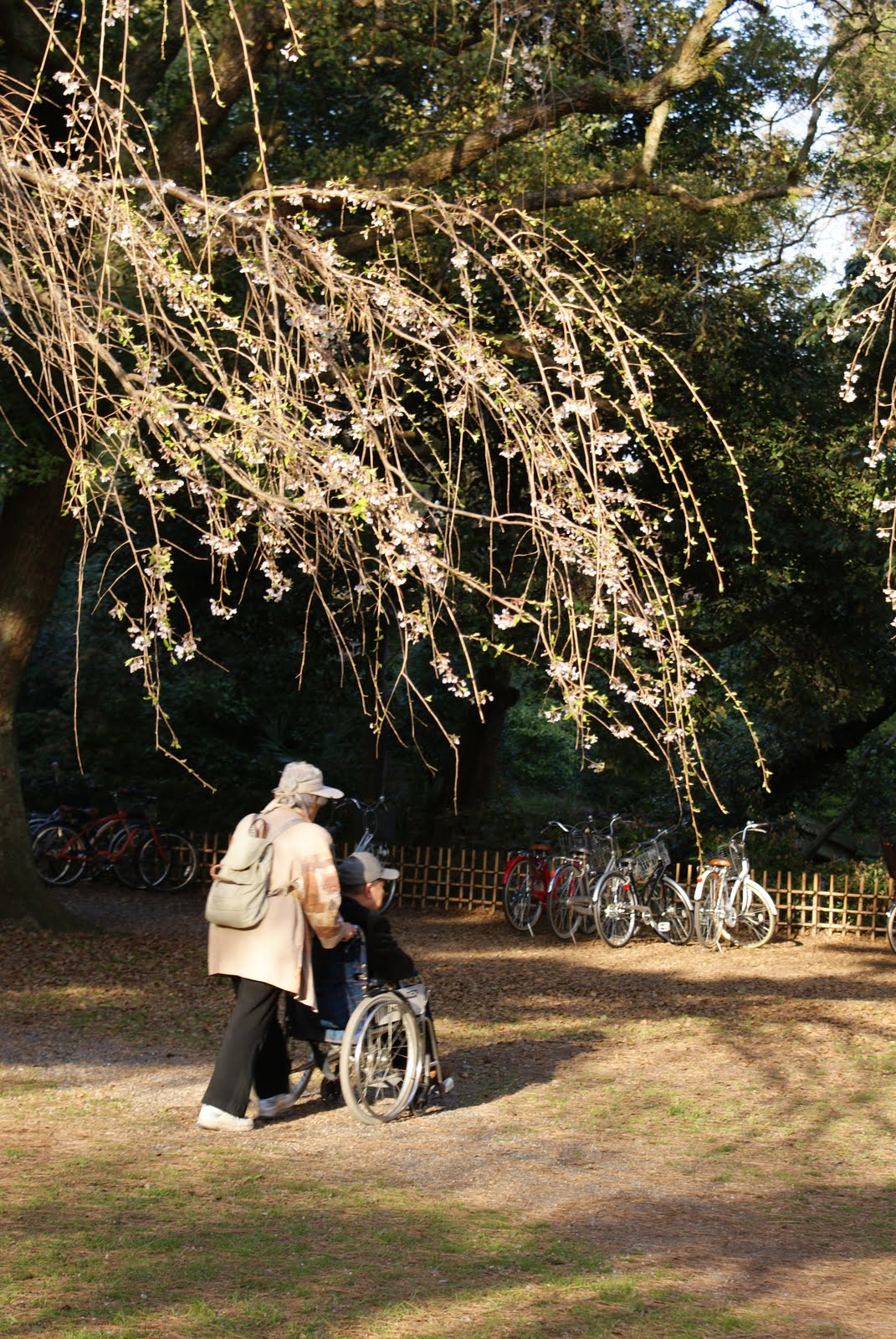
Yamazakura (山桜) in full bloom. Unlike the more common Somei Yoshino, the Yamazakura puts out leaves and flowers at the same time.


When it comes to dating, age is no barrier.


Neither is species.


This Kyoto resident has a gimpy back leg; he doesn't walk so much as limp and hop. But given how well the rest of him looks, I don't think it matters to the people he lives with.


Winner of the Most Troublesome-Looking Picnic Award. Admittedly no portable karaoke machine or barbecue grill but lots of points for bringing glasses, ceramic sake flasks, actual sake cups (!) and jubako (stack of lacquered boxes), which increases the likelihood that the food was prepared at home, rather than raided from the nearest convenience store.


Sakura in a high wind.


Not everyone's interested in flowers. Here, a boy demonstrates how to uncover the secrets of the universe with a stick.


Sumo-wrestling In The Park, With Dog


Sunday In The Park, With Sakura

Monday, May 10, 2010

Building a vocabulary, one cut at a time


10th May 2010


And the word for today is 砥石 (pronounced toh-ee-shi*).

I decided to buy a whetstone while I still had fingers. You know what they say about blunt knives being more dangerous than sharp ones?

Absolutely true.


* If you can't pronounce the hyphens, don't worry about it.

Wednesday, May 05, 2010

First time lucky


5th May 2010


The Mainichi Daily News website runs an online haiku competition throughout the year and it is absurdly easy to take part. Last month, I went out to buy some groceries, came back, and did.

Tuesday, April 27, 2010

Rarer than a yeti sighting...


27th April 2010


...is a post in the other blog.

Sunday, April 25, 2010

Would you let this sleeping dog lie?


25th Sunday 2010


The days when Ayax the border collie accompanies his human to work (Mexican food van) are good days. If there is a limit to the amount of patting he will take from passing strangers, I have not discovered it yet.

Saturday, April 17, 2010

Plan A? What's that?


17th April 2010


Went for a walk by the Kamogawa to try to think my way through a knot. I didn't make any headway, mostly because I spent all my time taking photos.


Man's best furry.


Man's best feathery.


Friday, April 09, 2010

Bakumatsu arc #4: Restaurants, red-light districts and revolution


10th April 2010


PG-rated because the other instalments were and I don't want this one to feel left out.

...


Taking part in politics in the last years of the Tokugawa shogunate was not conducive to reaching a ripe old age.

Intimidated by the American warships that steamed up to Japan in 1853, the military government caved in to trade demands from the West. This sparked off a wave of anger in the country that eventually brought down the shogunate and led to the establishment of an emperor-centric government in 1868.

But the years leading up to this were dangerous ones for both those who supported the shogunate and those who opposed it. Apart from the battlefield deaths, there were also numerous fatalities from assassinations and forced suicides.

Pro-emperor activist Nakaoka Shintaro had his way of fortifying himself for a dangerous mission: he would go to a brothel. And according to his diary, he would run into the other members there, which meant that the rest of the evening was divided between talking about politics and making use of the facilities.

Much of the revolution seems to have been planned in red-light districts and restaurants. The reason usually given is that, in those times, these were the only two places where men could gather without drawing too much attention from the authorities. There were other meeting places. But the men do not seem to have tried too hard to use them.

In a quiet neighbourhood in the south-west of Kyoto city, a restaurant that served the activists still stands. Sumiya’s rooms – decorated with cloisonné and mother-of-pearl – stun even now but none of this can be seen from the front of the building, a severe stretch of dark wooden lattices.

This discretion matched the clandestine nature of the rebels’ work. Among those who gathered at the Sumiya were Sakamoto Ryoma and Saigo Takamori – key players in the anti-shogunate movement. Revolution could be an expensive business and they invited wealthy merchants to the restaurant in a bid to get them to donate to their cause.

Adding to the intrigue of those days, the Sumiya entertained customers from both sides. Members of the Shinsengumi special police force, who would have promptly arrested Ryoma had they seen him there, also favoured the restaurant, which was about 20 minutes’ walk away from their headquarters.


Banquets and dinner parties would be thrown at the Sumiya and geisha would be summoned – the restaurant was located in the Shimabara pleasure quarters – to sing and dance for the customers.

A party held one rainy evening in September 1863 is still remembered. Not long after its founding, the Shinsengumi split into two factions. One was headed by corps commander Serizawa Kamo. Prone to violent outbursts, he became even more unstable after his right-hand man died. His subordinate had been cornered in a brothel by the other faction earlier that month. Accused of extortion and neglecting his duties, he was pressured into commiting suicide there and then. The alternative was beheading, considered a dishonourable death.

Yet when the leader of the rival faction, Kondo Isami, invited Serizawa to a party at the Sumiya a number of days later, the commander attended with two of his men. Perhaps Kondo knew that the hard-drinking Serizawa would not turn down a chance to carouse.


Kondo made sure that the sake flowed and that there were women on hand to keep his guests’ cups filled.

By the time Serizawa and his men left, he had drunk so much that a palanquin had to be called to take him back to his quarters. His mistress joined him in his room and along with his subordinates and two women from the pleasure quarters, the revelry continued. It was only when they were too drunk to sit up that they went to sleep.

Outside, the rain kept falling. Undeterred by the storm, Kondo’s men went through the garden and into the house: they had come for the last of the Serizawa faction.

Serizawa tried to run but it did not take the assassins long to finish him off. The women of the pleasure district and one of his supporters fled in the uproar. Less lucky were the other subordinate and his mistress; they lay dead in the room where they had slept, their heads cut off.

The samurai’s fondness for red-light areas and restaurants meant that the women who worked there, whether as courtesans or maids, were in constant danger of being caught up in the violence of raids and assassinations.

But there were those who risked themselves willingly, entertaining clients from the other side in order to spy on them. The women may have done this because they believed in the cause they were supporting or because, like Ikumatsu the geisha, they had more personal reasons.

Ikumatsu was a geisha of the Sanbongi pleasure quarter, located near the Kamogawa with a view of the eastern hills beyond the river. She was a skilled dancer and musician but these may not have been the qualities that drew the attention of activist Katsura Kogoro. The samurai from the pro-emperor fief of Choshu was used to the attention of women. The photos of him in his youth – and the glib tongue he was said to have – explain his popularity.

Still, something about Ikumatsu prompted him to put up the huge sum needed to pay off her debts to her okiya, or geisha house, and buy her out. As a rebel leader, Katsura was forced at times to lie low until the attention of the shogunate forces shifted elsewhere. When Ikumatsu visited him in his hiding place, she would cause a stir because of her eye-catching kimono. Reckless this might have been but this side of her apparently captivated Katsura.

Meanwhile, radicals in Choshu were agitating for action. The fief was out of favour with the imperial court and they were convinced that this was because rival domains had usurped its position. On August 20, 1864, the Choshu troops that had gathered outside Kyoto advanced on the palace to eject the ‘interlopers’.

Hours later, the radicals were forced into retreat and the fires that broke out in the conflict destroyed thousands of homes. The furious court instructed the shogunate to punish Choshu and Katsura once again came into its sights, even though he had opposed the coup and did not take part in the fighting.

He went into hiding under a bridge on the Kamogawa, spending five days among the crowds of homeless who lived on the riverbanks. The story goes that Ikumatsu went to take him food and even when interrogated by the authorities, did not give him away.

Katsura managed to escape from Kyoto and about one and a half years later, represented Choshu in negotiations with Satsuma fief for an alliance that sealed the fate of the shogunate. He went on to become a prominent figure in the new imperial government. With him was Ikumatsu, whom he married.

About 150 years after the two of them met, lovers still pass under the bridges of the Kamogawa. But they live in a different Japan and as they wander beside the river, they do not have to risk their lives – though the same cannot be said of their hearts.


(All pictures taken at the Sumiya.)

Thursday, April 08, 2010

The garden up north


8th April 2010


The lights come on in the Kyoto Botanical Garden after dark for about a week during sakura season.


Somei Yoshino, probably the most common kind of sakura in Japan.


Weather forecast was for cherry blossom skies.


Glow-in-the-dark, cone-shaped sakura. Very rare.

Saturday, April 03, 2010

White nights in spring


3rd April 2010


The annual light-up in Gion Shirakawa.


The entrance to a tiny shrine.


Saturday, March 20, 2010

Sakura may hog the press...


20th March 2010


...but it's worth remembering that plum and peach trees can look like this.


Winter and spring in the same frame.

Friday, March 19, 2010

Let a hundred coaches zoom


19th March 2010


Sakura season has begun. Here's an earlyish one out of the gate at Kodaiji.

Wednesday, February 24, 2010

Spring until further notice


24th February 2010


Today was Carry Your Coat Day.

I wasn't aware of it until I went outside and saw people with coats slung over their arms or dangling from their hands.

Some may think that this is what happens when you've dressed for winter and the weather suddenly decides to do spring.

Not true. Carry Your Coat Day actually has its roots in an old custom. In the past, to welcome the arrival of spring - warm weather as opposed to the spring solstice when it was probably still freezing - people would take off a layer of clothing. A sign of their desire to get closer to the new season, as it were.

But spring wouldn't realise what they'd done if they simply took off their coats, jackets, haori or michiyuki and left them at home. Hence the custom of walking around while carrying your outerwear.

If you find yourself in Japan on Carry Your Coat Day, why not engage in an ancient folkway? Take off your coat - only your coat, mind, let's not get law enforcement officers involved - and carry it.

With little effort, you too can be part of Japanese culture.

Sunday, February 14, 2010

My pleasure


14th February 2010


First of all, to my Chinese readers and any reader celebrating with the Chinese this new year, gong hei fatt choy, xin nian kuai le, huat ah!

I'm going to do something a little different today: I'm going to explain myself. It's not something I usually do but because this is the new year and I've eaten far more pineapple tarts than someone running a low-grade fever should, I will.

It's the pineapple tarts talking. I may take down this post once they stop.

But for now, this is what they're saying:

I've been writing about Japan for almost three years now and one comment I hear fairly often is that the pieces are...different. Or if the other person's being blunt, strange.

And I don't mind that at all. I would like to know why people feel that way though (if you have any ideas about this, the comment section's all yours).

More than one reader has said that the columns don't seem to fit into the Review section of The Straits Times, which is where they appear every fortnight. The Review pages are for commentaries, where writers put forward an argument - and argue it out.

I've gone over some of the columns I've written and the closest thing some of them have to an argument? "Buses are nice." Or "flowers are nice". Or if I'm on a roll, "Flowers are really nice".

Different and, to be blunt, strange.

So what am I doing?

I'm answering this now to try to make it clearer for myself and to make sure I don't lose my way in easy jokes and easier opinions.

At their best, these pieces do not offer points of view; they are points of view. They do not express argument; they embody it. In the bones of the best of them are ideas that I have jumped on, shaken, dug my nails into when life bit and I would not cry out. The ideas left are those that did not break. As long as they are lived rather than just believed, those pieces can be written.

I do not bring opinions to the table; I build rooms out of them. If you would know what they are, look under the wallpaper, in the wood grain of the table, in the air that stirs when you enter.

I do this not because I believe there's anything wrong with pieces that state and argue with nothing up the writer's sleeve - they're efficient ways of sharing ideas and, done well, offer much pleasure.

But statement and argument and information speak to the mind, to habits - some would say, prejudices - of thought.

And we are more than creatures of mind.

To the part of you not much used to being addressed, I will speak for as long as I can.

I do not seek to change your mind and I know I cannot change you. All I can do is create spaces where you can, if you choose, speak to the self you seldom see - or to the self you're hoping to see though you're a little hazy on what that self looks like.

Making spaces. Making space. That's all.

If you will allow me, let me do this for you.


Thursday, February 04, 2010

Toshiya (通し矢) at Sanjusangendo


5th February 2010


Every year in January, an unusual archery competition is held on the grounds of Sanjusangendo, a temple in the south of Kyoto.

The current form of the Toshiya contest is in its 60th year but it dates back to 1609, when archers competed at one end of the temple’s western veranda to send as many arrows as they could into the target 118m away. They shot for 24 hours from six o’clock in the evening, taking a quick break after every 500 arrows. The current record was set in 1686 by a man called Wasa Daihachiro. He fired 13,053 arrows of which 8,133 hit the target.

Today’s competition is held beside the famous veranda and the morning section is for archers who turned 20 in the past year and have achieved at least the level of shodan – the first rung of a 10-step ladder.


Putting on the shooting glove before the contest starts. The thumb is pressed lightly to the first two fingers while the strap is adjusted.


The average Japanese bow used today is 2.2m long. Without a wall or floor bracket, it takes two people to string it: one to hold the tip and the other to loop the string around the other end.


Two arrows are usually fired in one round for kyudo, or traditional Japanese archery.


Waiting to enter the shooting area. Ideally, the bow and arrows extend behind the archer at the same level - rather like unfurling wings.


The moment of full draw. In the background, the veranda where the original Toshiya competition took place.


While most of the male participants wear the practice gear of white gi and black hakama (wide, pleated trousers), some opt for kimono. Men shooting in kimono have to remove their left arm from the sleeve first. In winter, this is not fun.


The first arrow is shot while holding the second at a prescribed angle. It's harder than it looks.


The last of the male entrants with the first of the female competitors waiting behind.


Reason Why People Prefer To Photograph The Girls No.1


Reason Why People Prefer To Photograph The Girls No.2


In a break from the regular gi and hakama, young female participants wear furisode - colourful kimono with sleeves draping down to the feet. The sleeves have to be tied back with a strip of cloth - tasuki - before the archer can shoot.


And after it's all over...


Herons for you, madam?


4th February 2010


If you have US$980 to spare, you may like to give these herons a good home.

Monday, February 01, 2010

Let's settle this like men


1st February 2010


Another frozen day at the dojo: stiff shoulders, numb hands and breath puffing out white.

But around 7pm, two cheesecakes appeared. They were ceremoniously sliced and everyone was invited to help themselves.

There was a catch though: you couldn't just take a slice from one of the cakes; you had to eat both.

Two boys from the dojo had each baked a cake and after eating, you had to say which you thought was better.

This is the Way of the Warrior - sometimes, you face down your opponent with a sword. Sometimes, with a bow. And sometimes, with cream cheese, double cream, sugar, crushed biscuits and yoghurt.

Of course, some would say that the only opponent you face is yourself but the main thing is to keep the cake coming.

Sunday, January 24, 2010

How do you know?


25th January 2010


A friend is wondering if she should quit a steady job to do something different and a little crazy.

Someone who knows us both asked how I knew I was ready to leave when I did the same thing about three years ago.

But the thing is, you'll never be ready. If you're trying to tell stories, you'll end up breaking more things than you build because humanity is huge and anything you make to hold it will crack. Our hands never seem big enough or wise enough. And there never seems to be enough savings in the bank.

So it's not a question of readiness at all. It's a question of whether you want to.

Do you?

Saturday, January 16, 2010

Winter weather update


16th January 2010


Just how cold is it in Kyoto right now?

Well, the other night, I took my clothes off to have a shower. And started sneezing.

That cold.

Thursday, January 07, 2010

Hatsu haircut


4th January 2010


The first haircut of the year. The hairdresser wasn't young but seemed strangely nervous, dropping the comb twice. Each time, a burst of shaky patter after he picked it up.

When he switched on the razor, I stopped breathing.

But nothing except hair was cut off. So say hello to the new me.
.
.
.
.
.
.
.
.


Thursday, December 31, 2009

Wishing you light in dark places


1st January 2010


明けましておめでとうございます。今年もよろしくお願いいたします。


Okera mairi at Yasaka Jinja, a popular shrine in Gion.

Friday, December 25, 2009

Bakumatsu arc: Progress report


26th December, 2009


Finally finished a 4,000-word epic on Sakamoto Ryoma. I now have to cut it down to about 1,000 words so it'll fit in the papers. But not tonight. It's past 3am so I shall just file away the sea of notes, excavate my bed out from under the history books and then fall into it.

Good night.

Thursday, December 24, 2009

Falling with grace


Christmas Eve, 2009


I wasn't going to post this but since this is the season of giving, here's a piece about a gift. And one more mystifying than three wise men popping up in a maternity ward. (The companion post is below.)

...

Mukai Kyorai was a poet with a plan.

In the garden of his cottage on the outskirts of Kyoto city were 40 persimmon trees. Their branches were hung with fruit ripening orange but he couldn’t possibly eat it all. And since fruit preserves had not been discovered in 17th century Japan, he couldn’t make jam either.

So he promised to sell the persimmons to a merchant from the city, receiving payment in advance. But that night, a storm blew up and in the darkness of his cottage, Kyorai heard things smacking the roof and plopping to the ground.

The next day, when the merchant returned, Kyorai was forced to give him his money back because most of the persimmons had fallen in the storm.

Kyorai does not seem to have been upset. He got a poem out of the experience and, because the storm had stripped the tree branches bare, a clear view of a nearby mountain. Some say he even achieved enlightenment.

In any case, he renamed his cottage Rakushisha – House of Fallen Persimmons – and an 18th century reconstruction still stands in the Saga district of Kyoto today. Many of those who visit are drawn by the connection with haiku giant Matsuo Basho: Kyorai was one of his chief disciples and played host to his teacher there.

But the story behind the hut’s name also catches at the mind because it overturns our expectations of how things should play out. The prospect of profit, a sudden storm and a destroyed crop: it should all end badly.

Underlying these expectations is the belief that nothing good can come from a fall. This belief is hardwired in the words we speak: ‘a fallen woman’, ‘fall into enemy hands’, ‘fall in battle’, ‘drop in sales’, ‘plummeting rankings’. To fall is to succumb to temptation or attack, to lose status, popularity or money. To fall is to become less.

Many of these expressions are found in Japanese and English. And they share another one: in both languages, you encounter love by falling in it. You don’t dance, skip or jump into love – you fall. Even if you land safely, the choice of words still betrays dismay at the powerlessness felt.

Our evolution – both as individuals and a species – is geared towards walking upright. If all goes well, we graduate from toddling to walking to running and to riding a bike. Falling is what happens when we fail. If we fall hard enough and in the wrong place, it ends in mud and blood.

This may explain our prejudice against the act, a prejudice revealed in yet another expression: fall from grace – a loss of someone’s good opinion.

Yet there is a different kind of grace though it also involves a fall. This is favour we have not earned, a gift that comes not because of something we have done or are expected to do but entirely because of the nature of the giver.

Landing like a fist in the gut, it knocks us off our feet. We build relationships and societies on ideas of reciprocity and contract. But to grace, our considered balances and agreements, spoken and unspoken, are a house of cards. It smiles – and blows.

So mystifying is grace that it is usually left to the divine. In human hands, giving is something that must be justified. If a present appears at an occasion other than a birthday or holiday, so will these words: ‘What’s this for?’

In human hands, giving must be explained, even if it’s with something as simple as ‘I saw this and thought of you’.

Gifts for no apparent reason terrify: like shopping with a credit card for things without price tags – you can’t relax until you’ve seen the size of the bill.

Not even charity comes close to grace. When you donate money, you expect it to be spent in certain ways rather than on, say, lap dancers. But grace gives much and asks nothing, not even a thank you.

How then to respond? You can always say, no thanks, and walk away. You can take grace for granted, which is accepting with your eyes closed. Or you can keep your eyes open and with hands held steady, receive.


But the last option is also the hardest because it means being prepared to fall. Like a storm that brings down promised persimmons, grace upsets expectations. Will you, like Kyorai the poet, then be able to step off the path of logical action and accustomed thought? Without knowing what lies at the bottom – it could be a poem, a view of a mountain, enlightenment or none of them – could you dive into the dark?

If your foot goes to the edge of the path then hesitates, it may be too soon for that final plunge. Practise with a less demanding tumble, a kind of Grace Lite.

It’s something easily found in the natural world and there’s a particularly nice example in the mountains northwest of Kyoto city. The Iwato Ochiba shrine is tiny, like the remote community it serves, but soaring gingko trees tower over it and in late autumn, they shower the shrine with yellow, fan-shaped leaves.

The moss and flagstones disappear under the gilt and the little wooden stage in the centre of the shrine floats in a sea of yellow.

I try to leave a donation but the access to the main building is closed off and the shrine deserted. Asked for nothing, giving nothing, I still walk on gold.

The wind breathes out and more gold leaf drifts down. It’s a fall that comes from grace – a fall, if you like, from grace.